
Acadia Parish Court Records After Arrest
Court records after a jail arrest in Acadia Parish are not the same thing as the public jail roster. The roster may show an arrest date, held-for agency, warrant charge, statute label, bond amount, detainer, and judge or commissioner who set bond. The court record begins when the matter is filed and docketed through the court system. In Acadia Parish, court-file access runs through the Acadia Parish Clerk of Court, while prosecution decisions are handled by the 15th Judicial District Attorney, which serves Acadia, Lafayette, and Vermilion parishes.
The arrest-to-court path is usually arrest or warrant service, booking at the jail or another holding facility, first appearance or bond handling, prosecutor review, filing by bill of information, indictment, complaint, or supporting affidavit, docketing with the clerk, hearings, plea or trial, and then disposition or sentencing. The DA may file the same charge shown on the roster, amend it, add charges, reduce it, dismiss it, or decline it. That is why Acadia Parish court records after an arrest must be checked at the court level before treating a booking charge as the final case result.
Booking and custody details remain useful. For custody and hold fields, use Acadia Parish jail inmate records. For public booking-photo limits, use Acadia Parish jail roster mugshots. Court records after a jail arrest answer a different question: what charges were filed, what the status is, which hearings occurred, and how the case ended.
Search Acadia Parish Court Records
The clerk's online-access route is the main starting place for filed court records after arrest. The Acadia Parish Clerk of Court publishes an online-access area for clerk systems, including Clerk Connect or DocuNet style services depending on record type and account access. Some records may require an account, subscription, fee-based access, or an in-person clerk counter request. A current jail roster entry does not guarantee that the court case is already filed, especially soon after arrest.
- Search the APSO roster first if the arrest is recent. Copy the name, arrest date, held-for agency, warrant number, statute label, and bond text.
- Open the Acadia Parish Clerk online access route and search by defendant name or case number if known.
- If the case is not found, allow time for filing or contact the clerk for record availability, older files, certified copies, and access limits.
- Compare filed charges with the jail roster. Filed charges can differ from booking charges or warrant text.
- For prosecution-side context, victim services, or charging decisions, use the 15th Judicial District Attorney route rather than the jail.
Court records after an Acadia Parish arrest may also require a clerk visit or phone inquiry when the online index is incomplete, gated, or not yet updated. Certified copies, older dockets, sealed matters, and records with restricted access should be handled by the clerk, not by a screen capture of a jail record.
Acadia Parish Court Search Fields
The research did not expose a single free public criminal-search form with every field visible, so the fields below reflect the Acadia Clerk online-access context and common clerk lookup paths. Use the jail roster as a source for starting facts, then search court records with court identifiers when they become available.
| Field Label | Type | Required | Options / Format Notes |
|---|---|---|---|
| Name / party name | Search field | Account or system dependent | Use defendant name when the case number is unknown. |
| Case number / docket number | Search field | Account or system dependent | Best when provided by the clerk, attorney, citation, or case notice. |
| Record type | Category selection | Varies | Criminal, civil, conveyance, mortgage, and other clerk categories may use different access rules. |
| Date range | Filter | Varies | Use the arrest date or filing date as a starting point. |
| Instrument or document number | Search field | Varies | More common for recorded documents, but may appear in clerk systems. |
Acadia Parish Charging Documents
Formal court records after a jail arrest are shaped by the charging document. In Louisiana practice, the prosecutor may file a bill of information, a grand jury may return an indictment, or early court papers may include a complaint, affidavit, or warrant materials. The name of the document matters because it shows who initiated the formal charge and how the case entered court.
| Document | Filed By | Common Use | What to Check |
|---|---|---|---|
| Complaint or affidavit | Officer, prosecutor, or court-supported filing | Early arrest or probable-cause record | Names, arrest facts, charge basis, and warrant links. |
| Bill of information | Prosecutor | Common Louisiana charging method for many criminal cases | Filed charge, statute, count number, and amendments. |
| Indictment | Grand jury | Serious felony cases and cases presented to a grand jury | Returned counts, filed date, and later amendments or dispositions. |
APSO roster hold reasons can include statute-style entries and warrant numbers, but that text is not a substitute for the filed charging document. The court record controls the prosecution record. When there is a conflict, ask the clerk for the court file and the DA for prosecution-side context.
Acadia Parish Charge Status
Charge status changes as a case moves. A charge may be pending at first filing, amended after prosecutor review, reduced as part of a plea, dismissed by the court, or marked nolle prosequi when the prosecutor does not pursue it. A jail arrest can also involve more than one hold. A person might have a local charge, a bench warrant, a probation hold, and a DOC or ICE detainer at the same time.
| Status | What It Means | Where It Usually Appears |
|---|---|---|
| Pending | The case or charge remains open. | Clerk docket and court minutes. |
| Amended or reduced | The filed charge changed after prosecutor or court action. | Bill of information, amended filing, or docket entry. |
| Dismissed | The court or prosecutor ended that charge without a conviction. | Docket disposition, minute entry, or order. |
| Nolle prosequi | The prosecutor elected not to proceed with the charge. | DA filing or docket disposition. |
| Guilty or no contest | A plea was entered and accepted by the court. | Minutes, plea forms, and disposition entries. |
| Sentenced | The court imposed punishment after conviction or plea. | Sentencing minutes and judgment records. |
Bond After Acadia Parish Arrest
Bond connects the jail record with the early court process. APSO roster samples showed cash-style bond amounts, commercial bond wording, $0 entries, detainers, DOC incarceration notes, and bonds set by judges or commissioners. Louisiana Code of Criminal Procedure article 230.1 requires prompt first-appearance handling for a person arrested without a warrant, including counsel, bail, and probable-cause issues. A bond amount on the roster should be confirmed with the jail and court before anyone tries to post it.
| Bond Type | How It Works | Acadia Parish Caution |
|---|---|---|
| Cash bond | Money is paid directly as ordered by the court. | Confirm amount and accepted method with APSO or the court. |
| Commercial or surety bond | A licensed bond company posts the bond under Louisiana rules. | The roster can display commercial bond wording. |
| Personal recognizance | Release is based on a court promise to appear. | Only applies if ordered by a judicial officer. |
| No-bond or $0 entry | May reflect no monetary bond, a hold, or a status that needs clarification. | Do not treat $0 as automatic release. |
| Detainer or other hold | Another agency can keep the person in custody. | DOC, probation, ICE, USMS, or another parish can block release. |
Louisiana Arrest Court Statutes
Louisiana public-record and criminal-procedure laws shape access to court records after a jail arrest. La. R.S. 44:31 is the baseline public-record access law. La. R.S. 44:32 addresses custodian duties and procedure. La. R.S. 44:3 adds limits for law-enforcement, prosecutive, and investigative records. La. C.Cr.P. art. 230.1 addresses prompt first appearance after a warrantless arrest.
The Louisiana public-record access statute is one of the statute sources used to separate open court records from restricted law-enforcement materials after an Acadia Parish arrest.
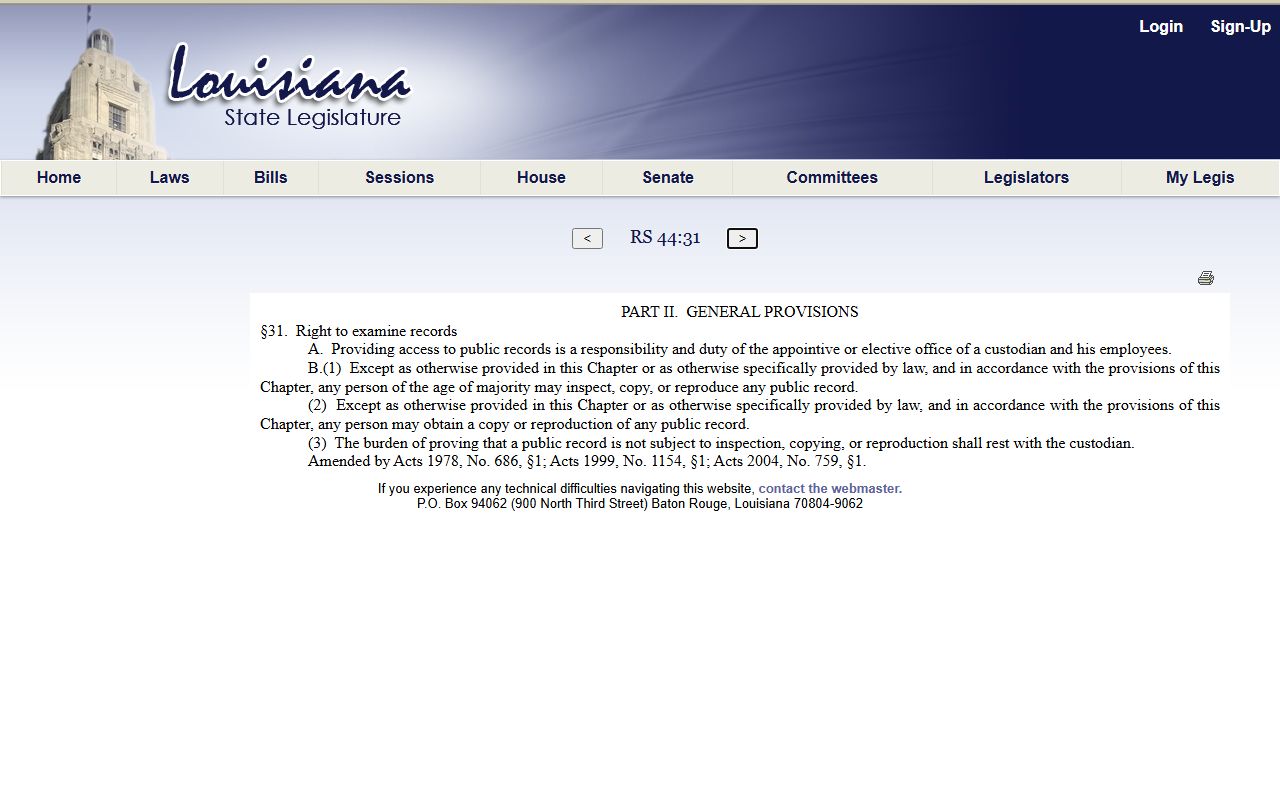
That statute source supports the records-access framework, while the clerk docket remains the place to verify the actual filed charges and case status.
Statute callout: Public access does not mean every arrest detail is open at all times. Pending investigations, juvenile records, sealed records, expunged matters, and protected personal data can be withheld or limited under Louisiana law.
Warrants Before Acadia Parish Arrest
APSO portal text says citizens can see outstanding warrants issued by the department, but the enabled public pages inspected for Acadia Parish did not show an active public warrant-search module. A warrant can still appear after booking as a hold reason in the inmate roster. Sample records showed arrest warrants, bench warrants, issuing agencies or courts, warrant numbers, charge names, bond amounts, and judicial officers.
For an outstanding warrant question, use caution. A person should contact counsel or the issuing court before appearing at the jail without knowing bond and hold consequences. The clerk may need to confirm bench warrants tied to court cases. Municipal courts and police departments may hold city warrant information before a person is transferred to APSO. Federal, DOC, probation, ICE, or other-agency holds may appear only after booking or through separate agency systems.
Charges vs Convictions
A charge is an accusation or filed count. A conviction is a court result after a guilty plea, no-contest plea, verdict, or other adjudication that results in conviction. Court records after a jail arrest may show many steps before a conviction exists. Treating an arrest charge as a conviction is inaccurate and can cause serious harm.
| Point | Charge | Conviction |
|---|---|---|
| Stage | Arrest, warrant, complaint, bill of information, or indictment. | Final court result after plea, verdict, or adjudication. |
| Meaning | An allegation or count to be resolved. | A proven or admitted criminal result. |
| Can change | Yes. It can be amended, reduced, added, or dismissed. | Changes only through appeal, post-conviction relief, expungement, or other legal process. |
| Where to verify | Clerk docket, charging document, and DA context. | Disposition, sentence, minute entry, and judgment record. |
Sealed and Expunged Arrest Records
Restricted court records after an arrest require careful wording. Louisiana expungement law, including La. C.Cr.P. art. 989 and related provisions, governs when eligible arrest and prosecution records can be restricted from public access. An expungement does not mean every third-party copy disappears, and it does not make a public roster screenshot reliable as a current legal record.
| Point | Sealed | Expunged |
|---|---|---|
| Public visibility | Public access is restricted by court rule or order. | Eligible records are restricted under the expungement process. |
| Record still exists | Often yes, but access is limited. | Often yes for limited legal purposes, depending on the order and law. |
| How to confirm | Ask the clerk or court handling the file. | Use the court order and clerk record, not a commercial website. |
| Applies to | Juvenile, protected, sealed, or court-restricted matters. | Eligible arrests and prosecutions under Louisiana expungement law. |
Restricted Acadia Parish Records
Not every court record after a jail arrest is open to the same degree. Juvenile matters, ongoing investigations, sealed records, expunged cases, protected victim information, and some law-enforcement or prosecutive files may be withheld or limited. The clerk can explain whether a record is available, but legal advice should come from an attorney. The jail can confirm custody facts. It cannot certify the full court outcome for every charge.
Important: Acadia Parish arrest and court information is not a consumer report and must not be used for FCRA-covered screening decisions.
Public Record Search
Sponsored Results